
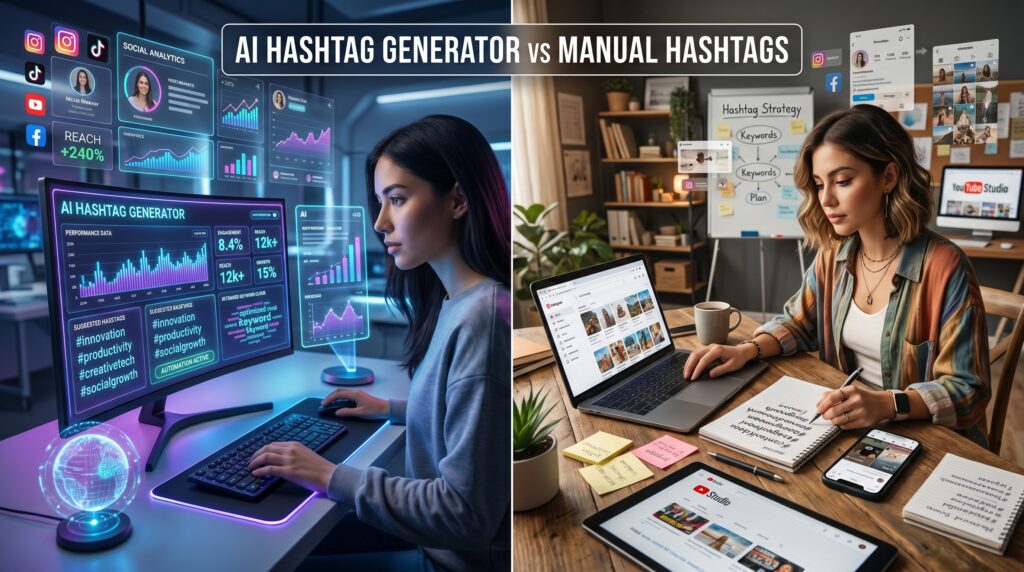
Hashtag strategies continue playing a major role in social media growth during 2026. Platforms like Instagram, TikTok, YouTube, Facebook, and X rely heavily on content categorization systems to improve discoverability and audience targeting. Because of this, creators and businesses constantly search for better ways to optimize hashtags for visibility and engagement. One of the biggest discussions in digital marketing today focuses on whether an AI hashtag generator performs better than manual hashtags.
Traditional hashtag research has existed for years. Influencers, marketers, and businesses manually searched trending topics, analyzed competitors, and selected hashtags based on experience. However, artificial intelligence has transformed this process completely. Modern AI hashtag generator tools now analyze trends, audience behavior, competition levels, and engagement patterns automatically. These systems can generate optimized hashtag suggestions within seconds, saving creators large amounts of time.
The rapid rise of AI-powered optimization has created debate across the social media industry. Some experts believe AI systems are more effective because they use real-time data and automation. Others argue manual hashtags still provide stronger contextual understanding and authentic audience targeting. Understanding how both approaches work is important for creators, bloggers, influencers, businesses, and marketers trying to improve social media SEO and online visibility in increasingly competitive digital spaces.
Why Hashtag Strategies Still Matter in 2026
Hashtag strategies remain highly relevant because social media platforms continue depending on categorization systems to organize content. Every day, millions of videos, images, reels, and posts are uploaded online. Without hashtags and keyword systems, platforms would struggle to understand which audiences should receive specific content recommendations. Modern algorithms analyze hashtags together with watch time, captions, engagement signals, and user behavior before deciding how content should be distributed.
The role of hashtag optimization has evolved significantly over the years. Earlier social media platforms relied mainly on chronological feeds, meaning popular hashtags often generated large visibility quickly. In 2026, algorithms focus more on personalization and engagement quality. Despite this shift, hashtags still provide essential contextual information that helps recommendation systems categorize posts accurately. This is why both manual hashtag research and AI hashtag generator tools remain important for creators aiming to improve discoverability and audience reach.
How AI Hashtag Generator Tools Work
An AI hashtag generator uses machine learning and social media analytics to identify hashtags likely to improve visibility and engagement. These systems scan massive amounts of public data across platforms to understand which hashtags are currently trending, which topics are gaining popularity, and which keyword combinations perform best within specific niches. Instead of relying only on manual searching, creators receive optimized suggestions instantly through automation.
Advanced AI hashtag generator systems can also analyze captions, photos, videos, and audience behavior patterns. For example, a travel creator uploading beach photography may automatically receive hashtags related to tourism, vacation trends, photography communities, and destination marketing. This contextual understanding allows artificial intelligence systems to generate more targeted recommendations than basic keyword tools used in previous years. As social media algorithms become more advanced, AI-driven optimization increasingly helps creators compete in highly saturated digital environments.
The Strength of Manual Hashtag Research
Manual hashtag research continues offering advantages because human understanding remains valuable in social media marketing. Experienced creators often know their audience preferences, niche communities, and cultural trends better than automated systems. They understand how specific hashtags connect emotionally with followers and how certain communities interact online. This personal insight helps create more authentic hashtag strategies aligned closely with brand identity and audience expectations.
Creators using manual hashtag methods also maintain greater control over content positioning and audience targeting. Human decision-making allows marketers to respond carefully to sensitive trends, regional language differences, humor, and community behavior patterns that AI systems may misunderstand. Many successful influencers still prefer manual adjustments because purely automated hashtags sometimes feel repetitive or disconnected from their content style. This is why many marketers continue blending personal research with AI-generated recommendations instead of relying entirely on automation.
AI Hashtag Generator vs Manual Hashtags for SEO
Social media SEO has become increasingly important because platforms now function similarly to search engines. Users search directly on Instagram, TikTok, YouTube, and Pinterest to discover tutorials, products, reviews, travel inspiration, entertainment, and educational content. Hashtags help algorithms understand what content is about and which audiences may find it relevant. This makes hashtag optimization a critical part of digital visibility strategies.
AI hashtag generator tools support social media SEO by analyzing keyword relationships and trending search behavior in real time. These systems identify optimized hashtag combinations capable of improving discoverability through recommendation feeds and explore pages. Manual hashtags still perform well in niche-focused communities where creators understand audience intent deeply. However, AI systems usually provide stronger data-driven optimization for broader reach and trend analysis. Combining AI suggestions with human refinement often produces the best long-term SEO performance across social media platforms.
The Speed Difference Between AI and Manual Research
One major advantage of AI hashtag generator tools is speed. Artificial intelligence can process thousands of hashtag combinations, engagement metrics, and trend patterns within seconds. This allows creators to react quickly to viral trends before they disappear. Fast-moving platforms such as TikTok and Instagram Reels reward creators who participate in trends early, making rapid optimization extremely valuable.
Manual hashtag research requires significantly more time because creators must analyze trends, competitors, audience behavior, and search results individually. Although this slower process may improve personalization, it often becomes difficult to maintain consistently across daily posting schedules. Businesses and influencers managing large amounts of content increasingly rely on AI automation because it reduces workload while improving efficiency. Speed alone does not guarantee success, but fast optimization combined with quality content can significantly improve discoverability opportunities.
Common Problems With AI Hashtag Generator Tools
Despite their advantages, AI hashtag generator tools are not perfect. One common issue involves over-optimization. Some AI systems recommend extremely popular hashtags with intense competition levels. Smaller accounts often struggle gaining visibility within these crowded categories because millions of competing posts already dominate search results and recommendation feeds.
Another challenge is contextual misunderstanding. Artificial intelligence analyzes patterns and data but sometimes lacks emotional understanding, cultural sensitivity, or humor interpretation. Certain hashtags may technically match a topic but still feel unnatural to human audiences. Automated systems can also produce repetitive hashtag combinations across multiple posts, making content appear less authentic. This is why creators should review AI-generated hashtags carefully instead of copying suggestions automatically without considering audience relevance and brand voice.
Why Hybrid Hashtag Strategies Are Growing
Many digital marketers now prefer hybrid hashtag strategies because they combine the strengths of automation with human creativity. In this approach, creators use an AI hashtag generator to identify trends, analyze keyword opportunities, and generate optimized suggestions. Afterward, they manually adjust hashtags based on audience understanding, content style, and niche relevance. This balance often produces stronger discoverability while maintaining authenticity.
Hybrid strategies are becoming increasingly popular because social media algorithms continue growing more complex. Artificial intelligence helps identify opportunities quickly, while human refinement ensures content feels natural and community-focused. Businesses especially benefit from hybrid systems because different campaigns often require different optimization approaches. A balanced strategy allows creators to improve efficiency without sacrificing audience connection. Many experts now consider hybrid optimization one of the most effective long-term methods for sustainable social media growth.
The Future of AI Hashtag Generator Technology
Artificial intelligence will likely continue transforming hashtag optimization during the coming years. Social media platforms already experiment with automated topic recognition, predictive trend analysis, and AI-powered recommendation systems capable of understanding content context more accurately than before. Future AI hashtag generator tools may automatically suggest optimized hashtags while creators edit videos, captions, or images in real time.
Human creativity, however, will remain important because online communities depend heavily on emotional connection and cultural relevance. Algorithms may become more intelligent, but authentic communication still influences audience trust and engagement. The future of social media optimization will likely focus on collaboration between machine intelligence and human creativity rather than complete automation. Creators and businesses capable of balancing both strengths effectively will continue gaining advantages in visibility, engagement, and long-term digital growth.
Internal Link Suggestions
- Instagram hashtag guide
- Best viral hashtag tools in 2026
- How social media SEO works
- TikTok hashtag strategy guide
Frequently Asked Questions
What is an AI hashtag generator?
An AI hashtag generator is a tool that uses artificial intelligence to create optimized hashtag suggestions based on trends, engagement data, and content topics.
Are manual hashtags still useful?
Yes, manual hashtags remain useful because they provide personal understanding, audience targeting, and contextual relevance.
Which method is faster?
AI hashtag generator tools are much faster because they analyze large amounts of data automatically within seconds.
Can hashtags improve SEO?
Yes, hashtags help social media platforms categorize content and improve discoverability through search and recommendation systems.
Why do creators combine AI and manual hashtags?
Hybrid strategies combine AI speed with human creativity and audience understanding for stronger optimization results.
Do hashtags still work on Instagram and TikTok?
Yes, hashtags remain important for content discovery, explore pages, and recommendation systems on both platforms.
Can AI-generated hashtags feel unnatural?
Sometimes yes, because AI systems may not fully understand emotional tone, humor, or niche community behavior.
What is the future of hashtag optimization?
The future will likely involve smarter AI systems combined with human creativity and personalized audience targeting.
Conclusion
Hashtag optimization continues evolving rapidly as artificial intelligence changes the structure of social media marketing in 2026. An AI hashtag generator provides speed, automation, trend analysis, and data-driven optimization capable of improving discoverability more efficiently than traditional methods alone. Manual hashtags still remain valuable because human creativity and audience understanding help maintain authenticity and contextual relevance. Most successful creators now combine both approaches through hybrid strategies balancing automation with personal insight. As competition across digital platforms continues increasing, intelligent hashtag optimization will remain essential for social media growth and long-term online visibility.